The Artemis program is a series of Moon exploration missions for scientific experimentation, technological advancement, and learning. It is led by NASA and run in collaboration with several space agencies, including the Canadian Space Agency.
The Artemis I mission successfully sent the Orion spacecraft around the Moon in 2022, without any humans onboard. The current mission, Artemis II, sends four astronauts around the Moon in the Orion spacecraft. They will be the first humans to venture into deep space since the Apollo 17 astronauts in 1972. Future missions intend to land humans on the Moon.
Who is travelling around the Moon?
Artemis II Crew from from left: Christina Koch, Reid Wiseman, Victor Glover, Jeremy Hansen. Photo: NASA/Josh Valcarcel
The Artemis II mission sends a crew of four Astronauts around the Moon on the Orion spacecraft.
The mission marks the first time a woman (Christina Koch, NASA) and a Person of Colour (Victor Glover, NASA) are on a lunar mission.
In addition, Canadian Space Agency astronaut, Jeremy Hansen, is the first non-NASA astronaut on a lunar mission.
Reid Wiseman (NASA) is commander of the mission.
How are we travelling around the Moon?
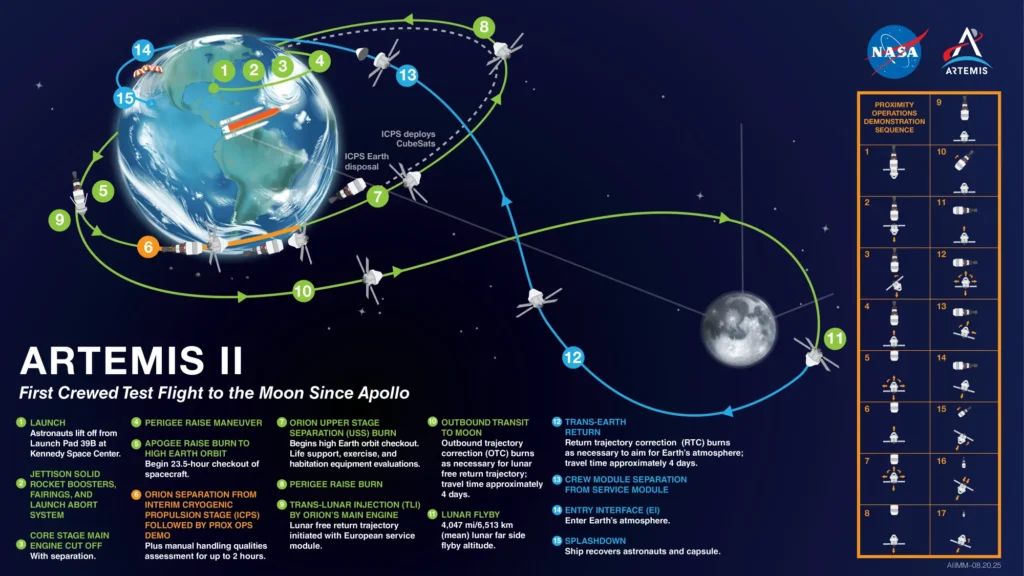
While the Artemis II crew won’t be landing on the Moon during this mission, their ~10-day mission will take them around the Moon in a figure 8 pattern. At one point, they will travel almost 7,500 km beyond the far side of the Moon! They will test the Orion spacecraft hardware and perform various experiments that the scientific community can use to understand astronaut health. This will help plan for safety during future human missions.
To reach the Moon, the Artemis II crew will exit Earth on the Space Launch System (SLS) rocket, the most powerful rocket ever to be made. They will travel in the Orion spacecraft. This spacecraft is designed and capable of traveling ~65,000 km from Earth, the farthest a spacecraft carrying humans has ever travelled.
Artemis II flight trajectory. Image: NASA
What is Canada's role in this mission?
Canada was invited to participate in Artemis II because of our expertise in robotics and our contribution of Canadarm2 to the International Space Station.
Canada is also leading the development of a lunar utility rover to support future Artemis missions. This utility rover will transport cargo, assist astronauts, and conduct scientific research on the Moon’s south pole region. This commitment led to Canadian astronaut, Jeremy Hansen, being part of the Artemis II crew. Canadian Space Agency Astronaut, Jenni Gibbons, was Jeremy Hansen’s backup and is acting as an Artemis capcom person, communicating with the crew from Mission Control while the crew is in space.
Why are we going to the Moon?
A full Moon behind NASA’s Space Launch System and Orion spacecraft. Photo: NASA/Sam Lott
Visiting the Moon will help us answer questions that arose during the Apollo missions.
The lunar farside, which we can’t see from Earth, is geologically unique. Studying its geological formations could help us understand how our solar system formed, how the early Earth looked, and how the Moon formed.
Scientists have also used satellite data to discover areas near the Moon’s poles with frozen water and other resources. These regions will be key for more scientific research.
Where can I follow along?
The Artemis II mission launched on April 1, 2026. The lunar flyby is scheduled for April 6, 2026, and the crew is scheduled to return to Earth on April 10, 2026.
You can watch live mission coverage on NASA’s official YouTube here.
Dr. Bhairavi Shankar is a Planetary Scientist, a Canadian Space Ambassador, and a social entrepreneur. She founded Indus Space, a social enterprise, to raise public awareness around Space Science and Exploration and its links to STEM. She loves to promote space science, Canada’s role, and multicultural professionals in the space sector.